
On paper, mobile umbrellas and cantilever umbrellas look like they solve the same problem: flexible shade. In real life, they solve it in very different ways.
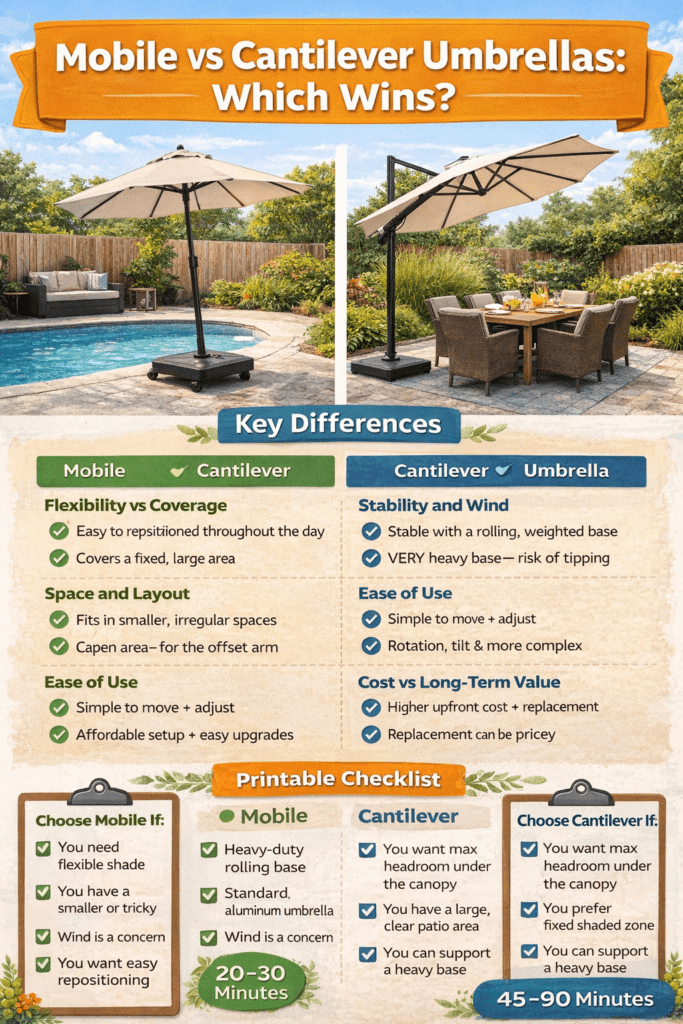
I’ve worked with both setups across patios, pool decks, and awkward backyard layouts—and the biggest mistake people make is assuming they’re interchangeable. They’re not. One prioritizes mobility and adaptability, the other prioritizes reach and open space.
Once you understand that, the decision becomes much clearer.
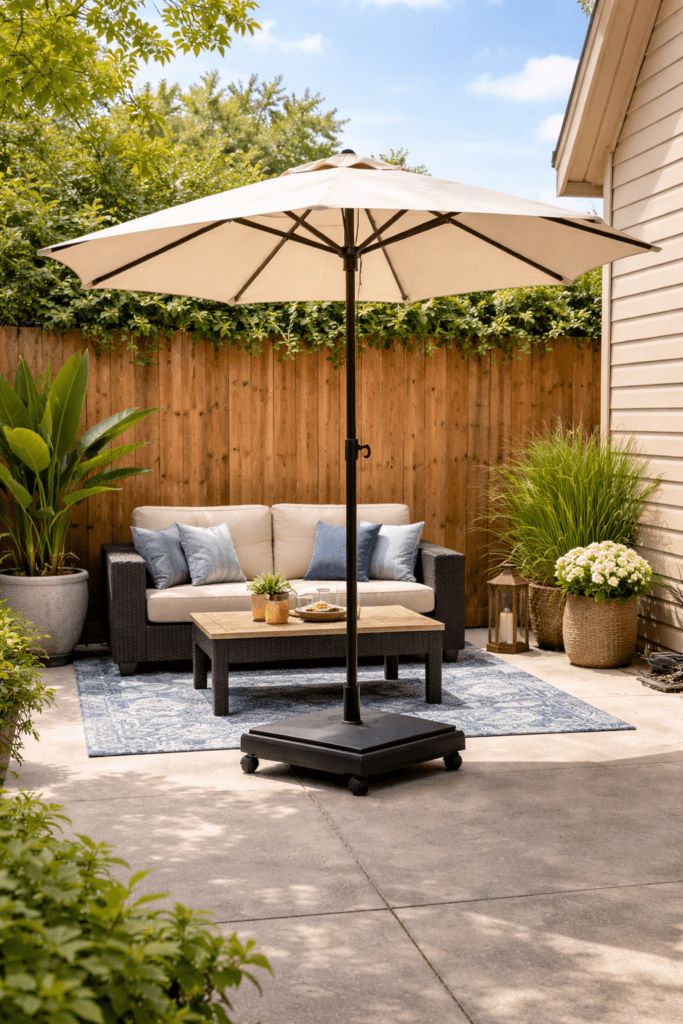
What Is a Mobile Patio Umbrella?
A mobile umbrella is typically a standard center-pole umbrella paired with a rolling base. Instead of locking it into one spot, you can move it throughout the day as the sun shifts.
Where it shines
- Small to medium patios
- Pool decks with changing sun angles
- Tight spaces near walls or fences
- Situations where flexibility matters more than size
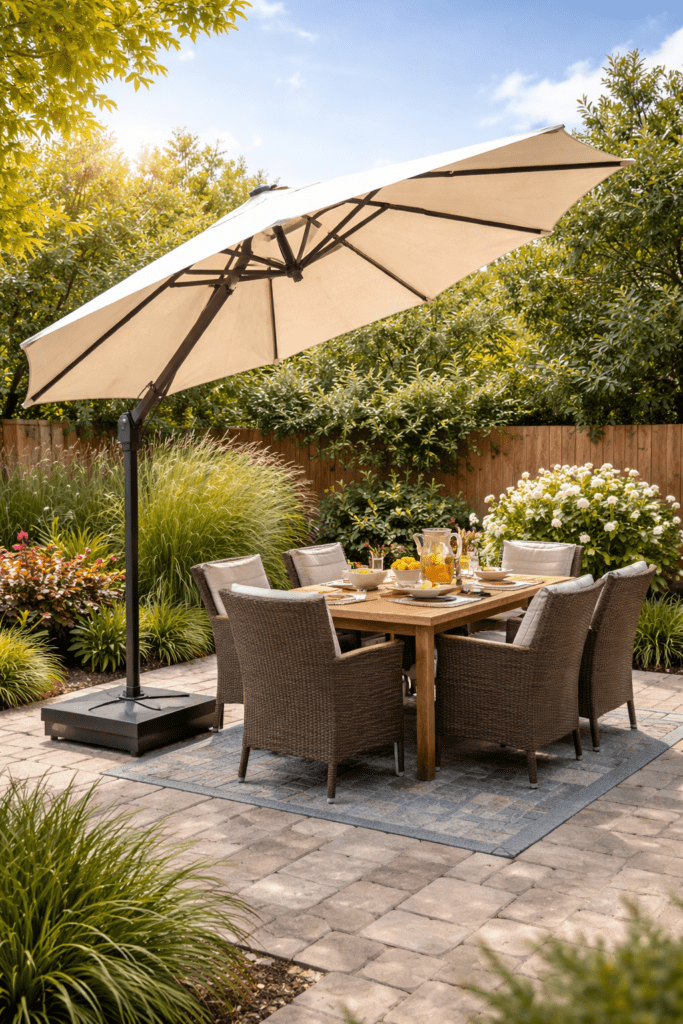
What Is a Cantilever Umbrella?
A cantilever (offset) umbrella has a side-mounted pole with the canopy suspended over your seating area. That means no pole in the middle of your table or lounge setup.
Where it shines
- Large dining sets
- Lounge areas with sectional seating
- Open patios where space isn’t constrained
The Key Differences That Actually Matter
1. Flexibility vs Coverage
Mobile Umbrella:
- Easy to reposition
- Can follow the sun throughout the day
Cantilever Umbrella:
- Covers a larger fixed area
- Limited repositioning (usually rotation + tilt only)
Reality check:
If your shade needs change hour by hour, mobile wins. If you want one big shaded zone, cantilever wins.
2. Stability and Wind Performance

This is where things get interesting.
Mobile Umbrella:
- Centered weight = naturally more stable
- Performs better in moderate wind when paired with a proper base
Cantilever Umbrella:
- Off-center weight = more leverage
- Requires significantly heavier base (often 100–200+ lbs)
Risk:
Cantilever umbrellas are more likely to tip if underweighted or exposed to wind.
👉 This is why many people end up switching to heavy-duty rolling umbrella bases for better control and repositioning.
3. Space and Layout Constraints
Mobile Umbrella:
- Works well in corners, against walls, or near structures
- Easier to tuck out of the way when not in use
Cantilever Umbrella:
- Needs clearance for the offset arm
- Can feel bulky in smaller spaces
Decision guidance:
If your patio is compact or irregular, mobile is usually easier to live with.
4. Ease of Use
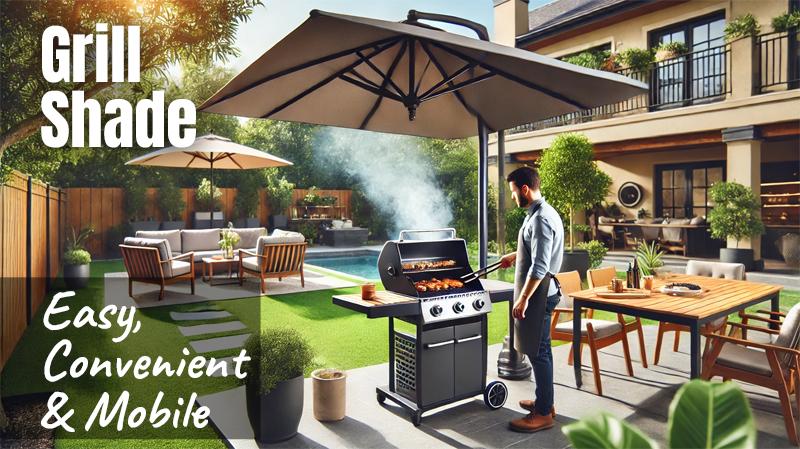
Mobile Umbrella:
- Move → lock wheels → done
- Simple adjustments
Cantilever Umbrella:
- Adjust tilt, rotation, sometimes height
- Heavier and more complex mechanisms
Trade-off:
Cantilevers offer more built-in adjustability, but mobile systems offer real-world simplicity.
5. Cost vs Long-Term Value
Mobile Umbrella Setup:
- Lower upfront cost
- Easier to upgrade base or umbrella separately
Cantilever Umbrella:
- Higher upfront cost
- Replacement parts can be expensive
Realistic expectation:
A poorly set up cantilever can fail faster than a well-supported mobile umbrella.
When to Choose a Mobile Umbrella
Choose mobile if:
- You want to move shade throughout the day
- Your patio has wind exposure
- You’re working with a smaller or irregular space
- You value simplicity and control
👉 Recommended:
When to Choose a Cantilever Umbrella
Choose cantilever if:
- You want unobstructed space under the canopy
- You have a large, open patio
- You prefer a fixed shaded zone
- You’re willing to invest in a heavy, stable base

Printable Checklist: Mobile vs Cantilever
Choose Mobile If:
✔ You need flexibility
✔ Your space is smaller or tight
✔ Wind is a concern
✔ You want easy repositioning
Choose Cantilever If:
✔ You want maximum overhead clearance
✔ You have a large seating area
✔ You prefer a fixed shade zone
✔ You can support a heavy base
Product Recommendations
To get the best results from either setup:
For Mobile Umbrellas
- Heavy-duty rolling bases → stability + mobility
- Locking wheel systems → prevent movement in wind
- Standard aluminum umbrellas → balance durability + weight
For Cantilever Umbrellas
- Oversized weighted bases (critical)
- Models with strong tilt + rotation controls
- Durable canopy materials for long-term use
Time to Complete Setup
- Mobile umbrella setup: 20–30 minutes
- Cantilever umbrella setup: 45–90 minutes (heavier, more parts)
- Ongoing adjustments: 1–2 minutes daily
Frequently Asked Questions
Which is better for windy areas?
Mobile umbrellas are generally more stable, especially when properly weighted and positioned.
Are cantilever umbrellas worth the extra cost?
They can be—if you need the open space and have the room and base support to handle them.
Can a mobile umbrella replace a cantilever?
In many cases, yes. Especially if you’re willing to reposition it instead of expecting one fixed shade zone.
Do rolling bases stay stable?
Yes—if they are heavy-duty and locked in place. Cheap versions are not the same as properly designed systems.
What’s the biggest mistake people make?
Buying based on looks instead of how they’ll actually use the shade throughout the day.
Resources for More Information
🌿 American Society of Landscape Architects – Outdoor Design Planning
- ASLA Climate & Design Resource Guides
This resource hub includes planning tools and guidance for designing outdoor spaces with sustainability, climate, and usability in mind.
☀️ U.S. Department of Energy – Shade & Cooling Strategies
- DOE Landscaping for Shade Guide
Covers practical ways to use shade (trees, placement, structures) to reduce heat and improve energy efficiency in outdoor spaces.
🌱 University of California Agriculture & Natural Resources – Climate-Smart Landscaping
- UC ANR Sustainable Landscaping Guide (PDF)
Focuses on climate-appropriate plants, water efficiency, and long-term sustainable landscaping practices that improve durability and reduce maintenance.
Final Thoughts
This decision really comes down to one question:
Do you want your shade to stay in one place—or move with you?
Most people think they want a large, fixed shaded area. But after a few weeks of chasing the sun, they realize what they actually needed was flexibility.
If your outdoor space changes throughout the day, a mobile umbrella setup is often the more practical, lower-stress solution.
If your layout is large, open, and predictable, a cantilever can look great and work well—as long as you respect its need for stability. Get that part right, and either option can work. Get it wrong, and you’ll be fighting your umbrella all season.


